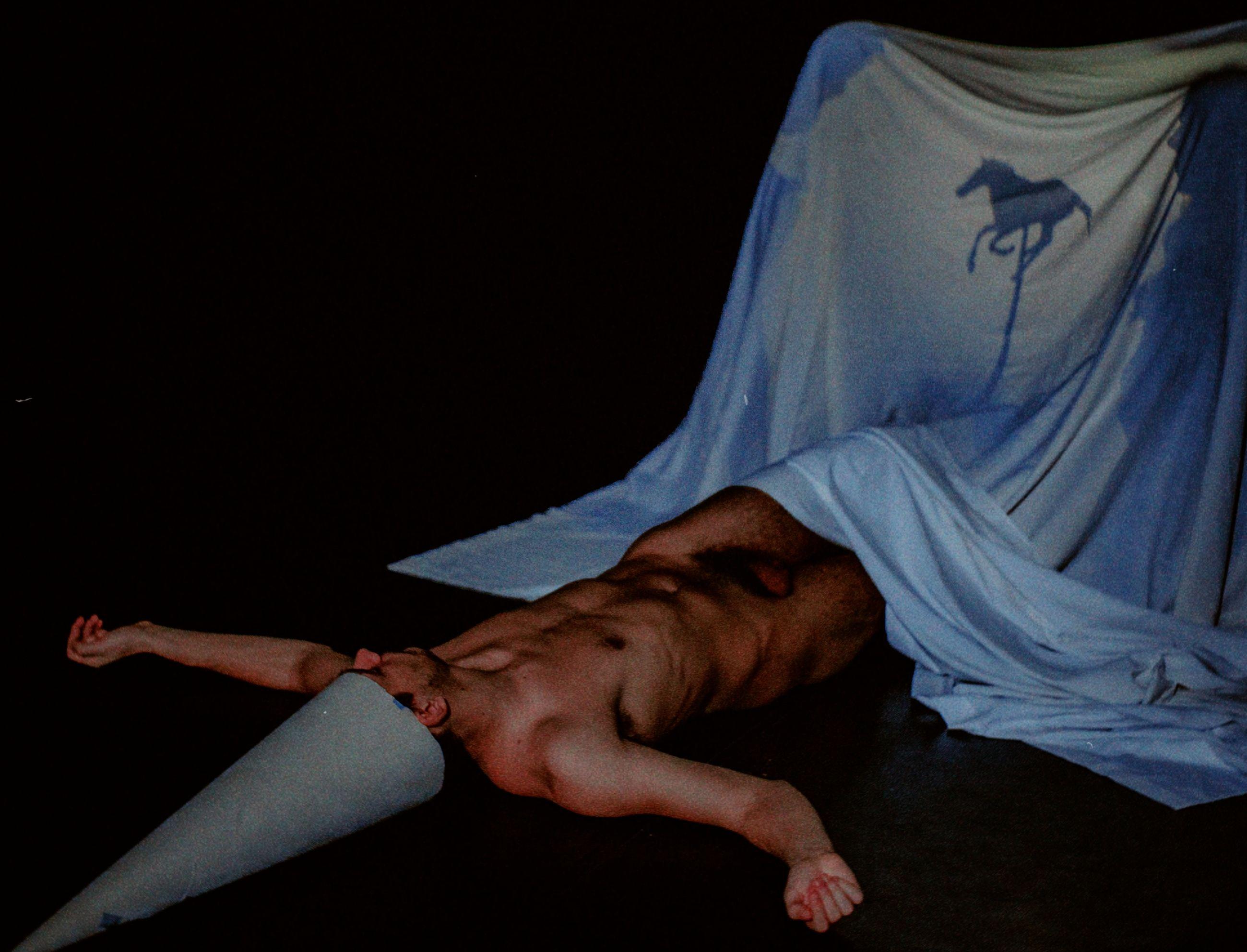
What do cavalry and a youthful body have in common? To be perfectly honest, I don't know either, but these are the first images that come to mind when I hear Maurice Ravel's Pavane for a Dead Princess. A pavane is a slow dance, associated with a procession of melancholic characteristics, with a weight and slowness that I feel carry a hidden speed. The truth that I find in this extended time of carrying a body tells me that I am looking to delay the burial of youth for as long as possible. Perhaps because I realize that I have left things behind, or because I feel that I did not experience slowly an adolescence that should have been eternal, I now find refuge in this time of the pavane to generate an endless, uncontrollable choreography. A fleetingness that will never slow down from the beginning to the end of this procession, thus questioning what is really the durability of the absence of pause, using time to its maximum. Can a body dribble itself on the field? Can wild horses and mares gallop backwards as an escape from a destructive future?
Life is like the plague, and youth is like the mountain. And we climb to the top of the mountain not to enter, but to leave ourselves behind, to let the horses and mares run free, towards death or purification. I believe the time has come to breathe less and sweat more.
— Daniel Matos